Nail disease and disorder.
Did you know that your fingernails can provide clues to your overall health?
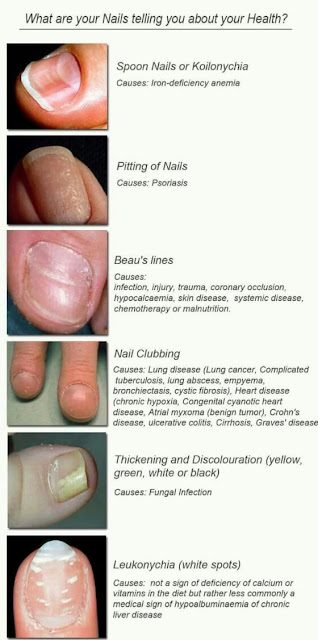
For example, ice pick-like depressions in the nails (nail pitting) are common in people who have psoriasis — a condition characterized by scaly patches on the skin. Nail pitting can also be related to connective tissue disorders, such as Reiter's syndrome, and alopecia areata — an autoimmune disease that causes hair loss.
Nail clubbing occurs when the tips of the fingers enlarge and the nails curve around the fingertips, usually over the course of years.
Nail clubbing is sometimes the result of low oxygen in the blood and could be a sign of various types of lung disease. Nail clubbing is also associated with inflammatory bowel disease, cardiovascular disease, liver disease and AIDS.
Spoon nails (koilonychia) are soft nails that look scooped out. The depression usually is large enough to hold a drop of liquid.
Often, spoon nails are a sign of iron deficiency anemia or a liver condition known as hemochromatosis, in which your body absorbs too much iron from the food you eat. Spoon nails can also be associated with heart disease and hypothyroidism.
With the condition known as Terry's nails, most of the nails appear white except for a narrow pink band at the tip.
Terry's nails can sometimes be attributed to aging. In other cases, Terry's nails can be a sign of a serious underlying condition, such as liver disease, congestive heart failure, kidney failure or diabetes.
With a condition known as onycholysis, the fingernails become loose and can separate from the nail bed. The separated part of the nail becomes opaque with a white, yellow or green tinge.
Sometimes detached nails are associated with injury or infection. In other cases nail separation is a reaction to a particular drug or consumer product, such as nail hardeners or adhesives. Thyroid disease and psoriasis — a condition characterized by scaly patches on the skin — also can cause nail separation.
With yellow nail syndrome, nails thicken and new growth slows. This results in a yellowish discoloration of the nails.
Nails affected by yellow nail syndrome might lack a cuticle and detach from the nail bed in places. Yellow nail syndrome is often a sign of respiratory disease, such as chronic bronchitis. Yellow nail syndrome can also be related to swelling of the hands (lymphedema).
Did you know that your fingernails can provide clues to your overall health?

For example, ice pick-like depressions in the nails (nail pitting) are common in people who have psoriasis — a condition characterized by scaly patches on the skin. Nail pitting can also be related to connective tissue disorders, such as Reiter's syndrome, and alopecia areata — an autoimmune disease that causes hair loss.
Nail clubbing occurs when the tips of the fingers enlarge and the nails curve around the fingertips, usually over the course of years.
Nail clubbing is sometimes the result of low oxygen in the blood and could be a sign of various types of lung disease. Nail clubbing is also associated with inflammatory bowel disease, cardiovascular disease, liver disease and AIDS.
Spoon nails (koilonychia) are soft nails that look scooped out. The depression usually is large enough to hold a drop of liquid.
Often, spoon nails are a sign of iron deficiency anemia or a liver condition known as hemochromatosis, in which your body absorbs too much iron from the food you eat. Spoon nails can also be associated with heart disease and hypothyroidism.
With the condition known as Terry's nails, most of the nails appear white except for a narrow pink band at the tip.
Terry's nails can sometimes be attributed to aging. In other cases, Terry's nails can be a sign of a serious underlying condition, such as liver disease, congestive heart failure, kidney failure or diabetes.
With a condition known as onycholysis, the fingernails become loose and can separate from the nail bed. The separated part of the nail becomes opaque with a white, yellow or green tinge.
Sometimes detached nails are associated with injury or infection. In other cases nail separation is a reaction to a particular drug or consumer product, such as nail hardeners or adhesives. Thyroid disease and psoriasis — a condition characterized by scaly patches on the skin — also can cause nail separation.
With yellow nail syndrome, nails thicken and new growth slows. This results in a yellowish discoloration of the nails.
Nails affected by yellow nail syndrome might lack a cuticle and detach from the nail bed in places. Yellow nail syndrome is often a sign of respiratory disease, such as chronic bronchitis. Yellow nail syndrome can also be related to swelling of the hands (lymphedema).


This is useful ! I think that nail depicts the health status as from what type of vitamin deficiency from we are suffering. Moreover, for increasing the growth of Vancouver Manicure you can adopt several types of vitamins to make your nails long and brighter.
ReplyDeleteHey that great information thanks for sharing it you can vist here for Pulmonary Rehab Centers near me, Best Respiratory Physiotherapy Clinic and chest physiotherapy for covid
DeleteNice Blog
ReplyDeleteGreat Information.
Make Course
#makeupCourse #NutritionCourse #HairCourse #SpaCourse #CosmetologyCourse #NailCourse #AestheticsSkinCourse
Now get 40% Discounts on all the courses at VLCC Institute without any hidden condition. Visit www.vlccinstitute.com to know more. Nails Course
ReplyDeleteAwesome blog. I hope you will share some more info about please keep sharing! Looking for physiotherapy in Bhopal, check out here
ReplyDeletePhysiotherapy in Bhopal
Great Information
ReplyDeletePhysio in Bhopal
Dermaklinic's Institute for Aesthetic Studies (DIAS), a brain child of Dr. Neeraj Pandey (MBBS, MD Dermatology, FADS International Skin Centre, Singapore), came into being to meet the ever-growing demand of skilled professionals in the field of dermatology. Our courses are designed with expertise to hone the skills of the students by imparting sound technical knowledge. Keeping ourselves abreast with the global trends we endeavor to create a capable and efficient support team for the aesthetic industry.
ReplyDelete:
Register today to begin your career!
-
website: https://www.thedias.org/
Contact Number: +917703000777
Emails: info@thedias.org / knockdiasforsuccess@gmail.com
Ensurecure | Multiple health centers in India with blood banks, IVF centers, diagnostic centers, etc. Effective ayurvedic clinic and yoga centers in India.
ReplyDeleteVery useful content. If someone is looking for Physiotherapy for Covid Patients in Bhopal city, you can check here
ReplyDeletePhysiotherapy for Covid Patients in Bhopal
Hey that's great article post in this page thanks for you can click here for Respiratory physiotherapy clinic, chest physiotherapy gurgaon , Pulmonary Rehabilitation physiotherapy
ReplyDelete